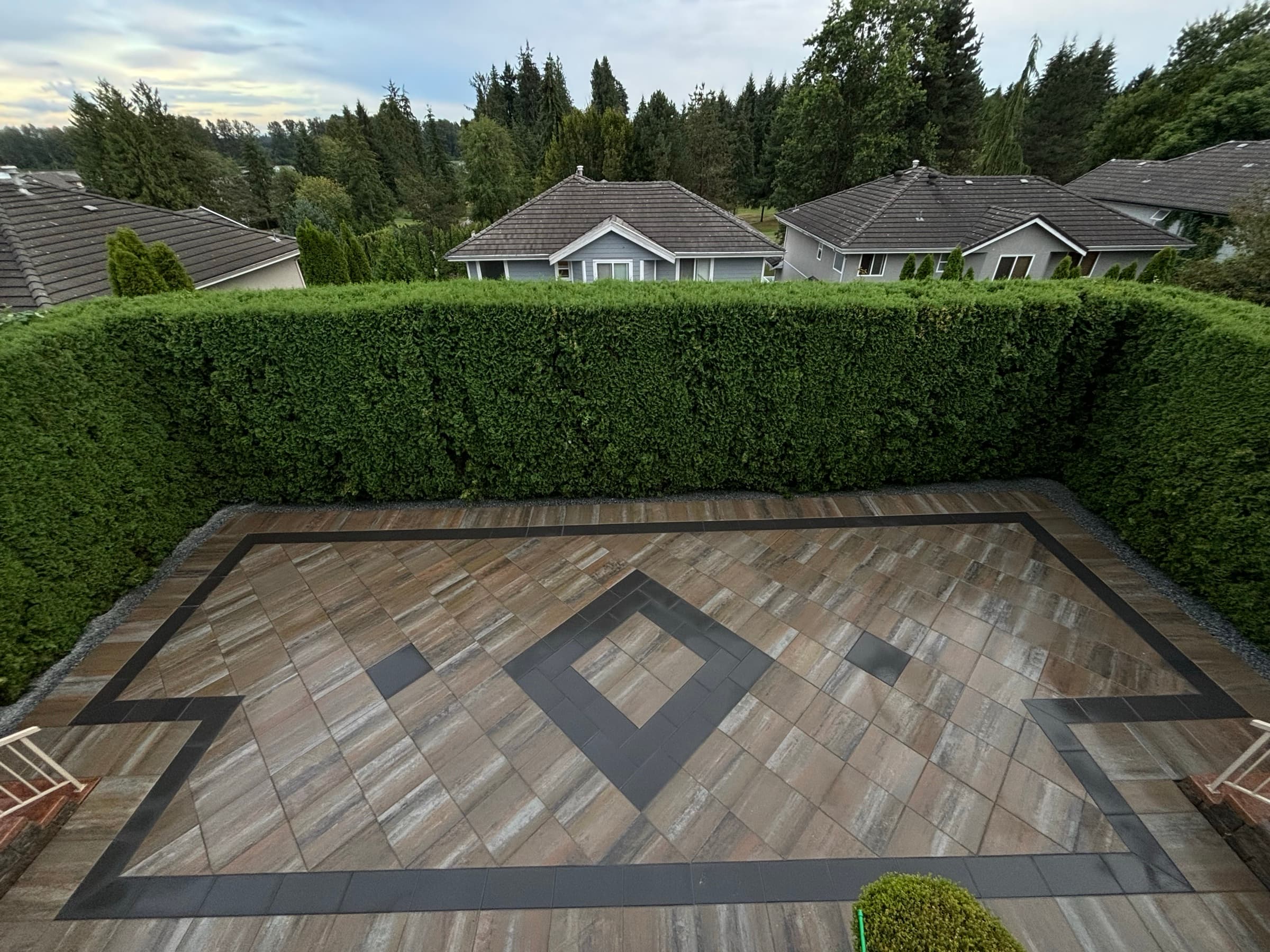
Overview
A paver patio is where most BC homeowners actually spend their summer, and it's also the surface we get called to fix most often. Not because pavers fail, but because the base under them was built for a dry afternoon instead of the seasons. The three things that wreck a patio are frost heave lifting the stones over winter, weeds colonising open joints, and settlement near a downspout where water has been quietly washing out the base.
We build patios on the same principles as a driveway, scaled to the load. Six to eight inches of compacted road base, an inch of bedding sand or chip screeded flat, edge restraint wherever the pavers meet grass so the field can't creep, and polymeric joint sand that hardens to lock the joints and keep weeds out. Before any of that goes in, we tie the patio into your yard's drainage so water moves off it instead of pooling under it. If you want a gas line for a future grill or conduit for lighting or a heater, that's cheap to run now and expensive to add later, so we ask about it up front.
On the material question, pavers cost 10 to 20 percent more than a poured concrete patio and are worth it for most people. Concrete looks tired in about eight years and cracks on a schedule you don't control. Pavers look the same in twenty, let water through, and let us lift and replace a single stone if something ever moves. If you're weighing the two, the pavers versus concrete breakdown in our White Rock patio guide walks through the real trade-offs and cost ranges.
We can also tie a new patio into an existing one if the old base is sound. If it isn't, we'll tell you straight rather than build good work on top of a bad foundation.
What's included
What we offer
- Full backyard patios
- Raised Patios
- Patio Extensions
- Permeable Patios
Process
How we
approach it.
- 01
Site walk
We look at slope, drainage, and the condition of your existing patio or hardscape. All of that shapes how we price out your options.
- 02
Tiered proposal
Design, finish, and maintenance options all affect the price. You get three options so you can pick the one that fits your needs.
- 03
Build
We design and build to your selected scope. Progress photos and daily updates so you can track where we are.
- 04
Completion
After the polymeric sand, you can use the patio within 24 hours. Our team gives you the maintenance playbook so you know how to protect the investment.
FAQ
Quick answers
Concrete or pavers, which is better?
Pavers cost roughly 10 to 20 percent more upfront, and for most people they're worth it. A concrete patio looks tired within about eight years and cracks on a schedule you don't control. Pavers look the same in twenty, let water drain through instead of pooling, and can be lifted and replaced one at a time if anything ever moves. Concrete has its place, but on a surface you'll actually live on, pavers age far better.
Will weeds grow in the joints?
Polymeric jointing sand prevents most of it. Unlike plain fill, it hardens between the pavers and locks the joints so there's little room for seeds to take hold. Over time it does wear, so we re-sweep and re-activate it every three to five years as part of our maintenance service. A patio that's kept jointed stays clean and tight; the weedy, spreading ones are almost always the ones where the joints were never sealed properly to begin with.
Can you tie into an existing patio?
Yes, as long as the existing base is sound. We cut a control joint where old meets new and integrate the two so it reads as one surface rather than a patch. If the existing base turns out to be bad, though, we'll tell you straight rather than build good new work on top of a failing foundation and watch the whole thing move together. Honesty about the base is the part that saves you money down the line.