Overview
A pool deck has three jobs most surfaces never have to think about. It can't be slippery when it's wet, it can't be too hot to cross barefoot at noon, and it can't shift when the ground around the pool moves. Get any one of those wrong and you've built a hazard, so the material and the layout matter as much here as the base.
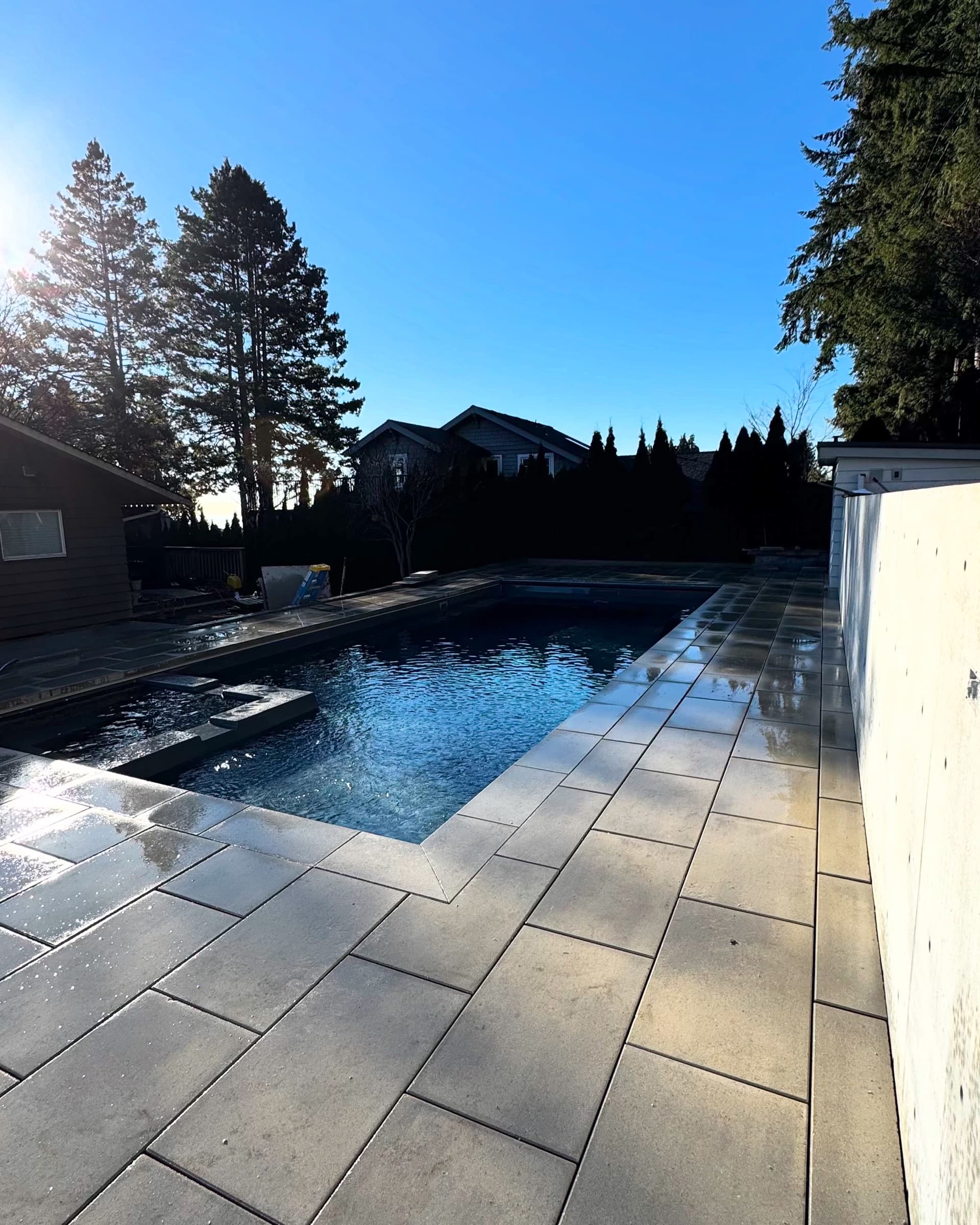
We select slip-rated pavers, R10 or R11 on the European rating scale, which grip underfoot when wet without feeling rough on bare feet. We keep the surface colour light and heat-reflective so it stays walkable in full sun. And we run the deck right up to the coping with a quarter-inch expansion gap filled with flexible sealant, so the coping and the deck can each move a little without fighting each other and cracking. Underneath is six inches of compacted base over geotextile, with a drainage channel tied to your yard outlet so water sheets off the deck instead of back toward the pool.
This is work we do on new pools and existing ones. On an existing deck we strip the old surface, evaluate the base honestly, and rebuild. Now and then an old base is sound enough to overlay, but that's rare and we won't pretend otherwise to save you a day of excavation. What drives the cost is the size of the deck, the paver line, the drainage, and any step lighting or integrated features you want built in. See finished pool decks in our work.
What's included
What we offer
- Permeable Paver Decks
- Permeable Slab Decks
- Standard Pavers
- Coping
Process
How we
approach it.
- 01
Site walk
We look at slope, drainage, soil, and discuss material preferences. This matters early on because choosing a coping, slab or paver that can work together cohesively will affect how we go about the install and coordinate with the pool contractor.
- 02
Tiered proposal
Three options at three price points. The differences are paver brand, base depth, and edge detail, with every line itemised so you know what you're paying for.
- 03
Build
We start excavation and prep if needed, then onto the coping, working alongside the pool contractor to nail down specifics of the install.
- 04
Completion
Polymeric joint sand or permeable jointing material. One last compaction pass to seat the pavers. Walkthrough with you before we leave.
FAQ
Quick answers
What does slip-rated mean?
It refers to the European R-rating scale, which runs from R9 to R13 and measures how much grip a surface has underfoot. For residential pool decks we use R10 or R11, which is genuinely wet-slip resistant without feeling rough or uncomfortable on bare feet. It's the single most important material choice on a pool deck, because a beautiful deck that turns slick the moment it's splashed is a hazard, not a feature.
How close to the pool can pavers go?
Right up to the coping, with a quarter-inch expansion gap filled with a flexible sealant. That small gap is doing real work: it lets the coping and the deck each move a little with temperature and ground shifts without pushing against each other and cracking. Butt them together tight and something eventually gives. The gap is the detail that keeps the edge looking clean for years instead of chipping along the pool line.
Can you do this on an existing pool?
Yes. We strip the old deck, evaluate the base underneath honestly, and rebuild. Every so often an old base is sound enough to overlay, but that's rare, and we won't pretend it's fine just to save ourselves a day of excavation and then have the new deck inherit the old one's problems. Most existing-pool jobs are a full strip and rebuild, and that's what makes the finished deck last.